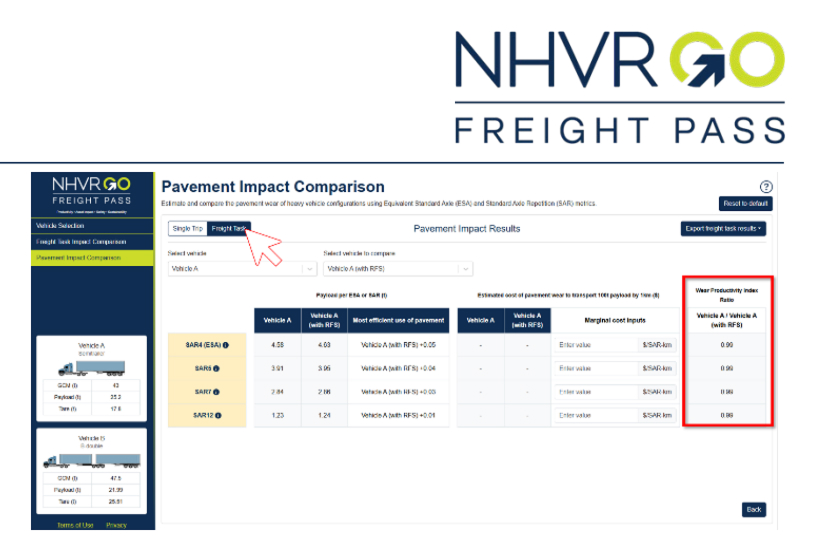
The National Heavy Vehicle Regulator (NHVR) is excited for local government road managers and industry to use the newly launched tool, Freight PASS. The interactive web app has been designed to help support productivity, asset management, safety, and sustainability outcomes for not only road managers, but the wider heavy vehicle industry.
The Freight PASS tool allows users to input various types of data, including the type of vehicle, load mass, trip length, average speed, commodity to estimate time, crash rate, fuel consumption, carbon emissions, average cost and estimated savings.
Heavy vehicle access decisions can be complex. In some cases, a vehicle that appears larger or more innovative may, over time, create less cumulative wear or risk than a smaller or more familiar configuration. This can make it challenging to ensure access decisions are consistently aligned with productivity, safety, sustainability and asset management objectives.
When assessing access for a recurring freight task, Freight PASS can help councils compare vehicle options using a broader set of measures, including the collective impacts over multiple journeys, rather than a single trip in isolation. Having this information aims to empower road managers with a clearer picture of how different vehicles may affect the network in practice.
The benefit for local government is greater confidence that decisions are based on potential real-world outcomes. Using Freight PASS, a road manager would be able to input their data and demonstrate that a 30m PBS A-double will complete a nominated freight task more safely, in half the time, with almost half the fuel consumption and carbon emissions than a 19m conventional semi-trailer.
This means having the data and information to support decisions and opportunities to allow safer, more sustainable, and productive vehicles on Queensland’s roads to meet the growing demands on the heavy vehicle industry. In using Freight PASS, road managers are more equipped with the information and confidence to grant access to higher performance vehicles.
For industry, Freight PASS can help operators present a more rounded case for access. For example, a freight business looking to improve efficiency on a regular freight task can use the new app to compare vehicle combinations and better understand the broader network impacts.
The result of this is operators are not only considering payload and trip efficiency, but also how a proposed vehicle may affect safety outcomes, emissions, and road assets over time. This can support more credible engagement with road managers, particularly where local governments are balancing freight needs with community expectations and infrastructure constraints.
Freight PASS aims to help all parts of the heavy vehicle industry – both operators and road managers – work and make decisions from a more complete picture. Industry can identify options that improve productivity, while also responding to road manager concerns. In that sense, Freight PASS supports a more collaborative approach, helping industry and government meet in the middle on solutions that are practical, efficient and better informed.
Users can visit NHVR Go to use the new Freight PASS web app for free, or to find out more information about the NHVR’s technological offerings.