
Matt, what are the biggest successes you’ve seen on the wharf in Australia and at Patrick?
I would nominate four things that have changed profoundly since I joined the industry in 1986…
• The focus on safety. This is a real and dearly held belief at every level of our business. It is not negotiable. Our Home Safely Everyday mantra has stood the test of time, and we are constantly looking for ways to improve the safety of our workplace. This is challenging as we work ships from around the world, of differing qualities and configurations. As we are fond of saying, our workplace changes every shift every day as we work different vessels, thus requiring situational awareness, well understood operational procedures, and a shared approach to keeping people safe.
• The systemisation of our operations through e commerce, remote control, and automation. We have introduced process characteristics into terminal stevedoring that have changed the face of the industry. Not just the obvious – the fact that the straddle carriers are now automated – but in other ways, such as the electronic transfer of import and export paperwork, and access to online booking systems to interface with the terminal. I started at a time when paper and pencil was still being used to fill out pro forma documentation, so this has been particularly significant and beneficial in reducing errors and expediting exchange of cargo handling information.
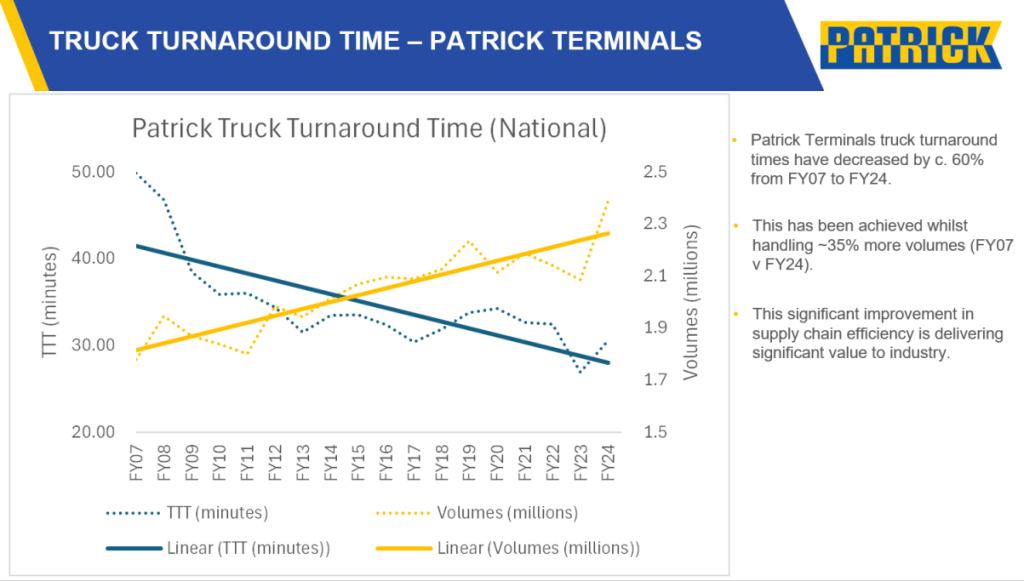
• The focus on our landside operations. This is something I am very proud of. Notwithstanding recurrent (yet largely performative) angst from the usual sectional interests, the evolution of our landside operations has been a standout success. Prior to the introduction of vehicle booking systems trucks would queue for hours outside terminals, at huge cost and impact on efficiency and asset use. Through adoption of booking systems, enhancement of gate processes (optical character recognition cameras) and now automated truck handling, we have been able to deliver world class truck turn times notwithstanding a considerable growth in cargo volume. The schematic below – delivered to a recent PBC Landside Logistics Forum – says it all. I have been around the world and have never seen a port environment in which the road transport operators, and by extension shippers, are so fulsomely accommodated as in Australia. Ask any long-time road transport operator, their engagement with the terminal now bears no resemblance to how it was in the dark days before the orderly management of the truck terminal interface.
• The last big change, and one that I have done my best to promote, is the increasing participation, and prevalence, of women on the waterfront and throughout the supply chain more broadly. Patrick launched its WILpower cadetship for young women seeking a career in stevedoring management in 2015. At that time, the number of women in operational roles could be numbered on one hand. The cadetship is now entering its fifth iteration and has delivered some remarkable women into our business. This has been mirrored by other stevedores and supply chain participants such that this is no longer an industry known for ‘fat blokes in blue singlets’ but rather a dynamic modern environment in which anyone with a strong work ethic and a desire to succeed can build a career. The change in demographics has been obvious and very much for the best.
With importers and exporters facing rapidly rising costs, can you share how Patrick are dealing with this same issues?
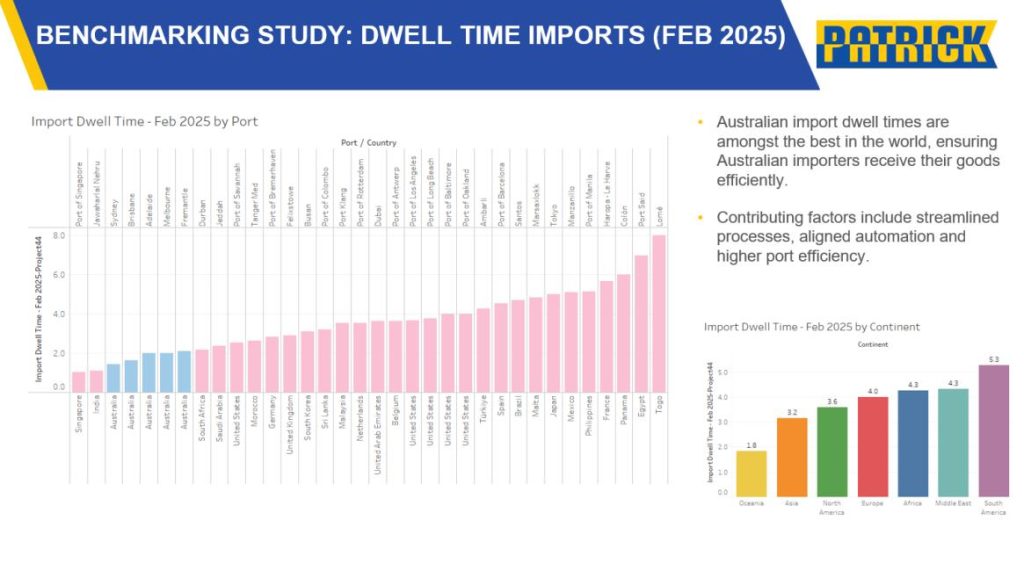
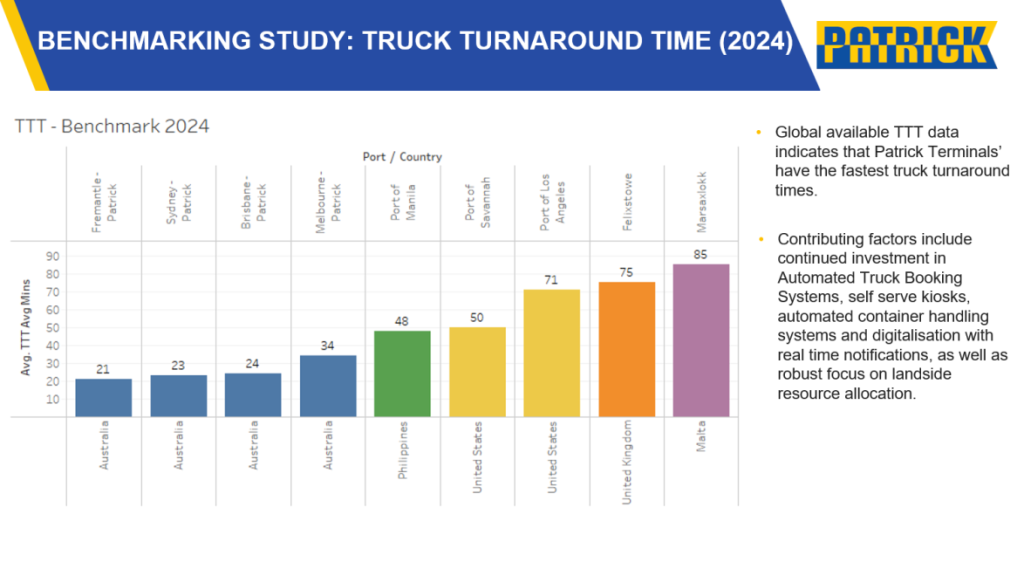
We are only a small part of the overall supply chain costs faced by importers and exporters; however, we believe our value proposition is sound and seek to aid shippers through fee structures that encourage exports while ensuring container dwell time and truck turnaround times are amongst the best in the world. These areas, if they ‘blow out’ represent real costs to shippers in things like container detention and truck demurrage charged by others in the chain. The following slides from the same LLF presentation referenced above show how we ‘stack up’…
Patrick is the only Australian stevedore – how to we ensure an Australian stevedore? Why does it matter?
Simple, take an interest in the supply chains your products use and book cargo on ships serviced by Patrick. The notion that ‘one size fits all’ and that one stevedore is as good as another is now manifestly incorrect. Each stevedore has its own truck terminal interface – all different – offering varying levels of resilience and efficiency.
Why does it matter to have an Australian stevedore? Because we are an island nation and to have a stevedore with over 100 years of operational experience focused wholly and solely on this country – rather than being part of a multinational business in which this country is just a small element – is surely better for Australian shippers. To be honest, our form of automation was developed in Australia for Australian conditions and is demonstrably better than that of our competitors which is a European form of automation inadequately equipped to deal with things like multi rig vehicles, that are largely peculiar to this country.
How do you see structural changes and potentially ongoing acquisitions around Ports impacting customers?
As noted above, stevedoring is no longer a homogenous set of businesses. As some players seek to vertically integrate, or shipping lines move further into the supply chain, these business will be differentiated from one another in terms of their imperatives and focus. I still maintain an Australian stevedore focused on Australian conditions and shippers is a necessary and valuable aspect of the market, and hope that this will be supported as the emerging differences in output and approach begin to set stevedores apart.
What challenges do you see on the horizon in the next 2 decades – and what advice do you have for supply chains in navigating them?
There are several, including the structure of the industry as companies attempt to vertically integrate or shipping lines become more directly involved, however, at a practical operational level, the availability of labour to supply chain participants will be a challenge. In areas such as trucking the workforce is aging and as such automation of road transport has to be pursued if we are to meet the cargo handling task. We should not fear automation, we should use it to power our industries moving forward, sensibly augmenting people in the performance of their work.
Strategically, Ports have to ensure that their links – both to the open sea and hinterland – are adequate and maintained. A port is only as good as these links and appropriate planning to ensure these are free from encroachment and fit for purpose (for instance the depth of approach channels) is critical.
You’re a passionate supporter of the Port of Brisbane, QTLC and other organisations working to improve our supply chains. What motivates you to go above and beyond your usual day job to help others? Do you have an example of where this support has unlocked solutions?
I am a great believer in our industry – stevedoring in particular. Whilst we are not perfect, we have done some great things in Australia which have garnered world recognition. Sadly, this does not get much coverage locally where the focus seems to be on the negatives, often tropes and stereotypes of another era. We open the terminal to the public each year as part of the Brisbane Open House programme and the most oft heard comment from the hundreds of visitors we get is ‘I did not know it was like this’. I am sure they expect to see people heaving sacks on their shoulders and are amazed to learn that we use robotic equipment and that our AutoStrads are home grown technology. I am on a one man crusade to change people’s perceptions of our industry and in so doing answer our critics and encourage more people, from a diversity of backgrounds, to consider a career in logistics.
What motivates you to tackle each issue you face head on? Is there a set of principles that guide you and have served you well?
I am a great lover of history and draw inspiration from many people and events of the past. As to a set of principles, I have always liked the 18th century Prussian King, Frederick the Great’s, pithy assessment of his position… “Ich bin der erste Diener meines Staates”, “I am the first servant of my State”. I take this to mean that you should lead from the front, encouraging people to come with you, not expecting others to do what you would not be prepared to do yourself. I have been blessed throughout my career to be surrounded by people far more talented than I, such that a collegiate approach to “tackling issues” is simply the best and most obvious way to proceed. So far so good.